Destress the Damsel Turns 10!
by 
On January 8, 2014, I published my very first “welcome” post on Destress the Damsel. It hardly seems possible that time has flown by so fast, but here I am 10 years later, bringing to you my 123rd article!
My hope is that every “damsel” who has visited my blog has come away in some regard a better wife, a better mother, a better woman. If one lady learned one thing from Destress the Damsel that she implemented into her life for good, this work has not been in vain. If one lady learned to love her husband or children a little bit more, if one lady learned to be a little bit more sensible or pure, if one lady learned to be a little bit better of a worker at home, or to be a little bit more kind, or a little bit better at subjecting to her husband…I say “mission accomplished”. (Titus 2:4-5)
For today’s article, I want to share a brief highlight reel of the last ten years with you. There will be a “Chaste’s Choice Award” for my personal favorite article from each year. (Yes, I went back and read all 122!) Sometimes it was incredibly hard to pick a favorite (whether because that year’s articles were so good or so bad, I’ll let you be the judge) but this list is about as definitive as it’s gonna get. At the end, I will reveal my #1 all-time favorite article. Are you ready for some nostalgia? Let’s take it back to 2014…

Chaste’s Choice: Erroneous Equality
In this early blog, Lil’ Baby Chaste shares about the importance of being a submissive wife in a world that demands “equality” for men and women. While I had a long way to go with my writing and organization skills 10 years ago, the scriptural truths found in Erroneous Equality stand the test of time.

Chaste’s Choice: Sporadic Surrender
This article cites several reasons why we should obey God on His terms, and at all times. Many proclaim their love for God, but those who are accepted are not those who engage in Sporadic Surrender, but those who live their lives in full surrender to God each and every day.

Chaste’s Choice: Father Knows Best
Light-years ahead of my first two years of blogging material, by this time I was using illustrations, introductions, conclusions, outlines, and photos in my articles. Father Knows Best addresses 5 significant ways that mothers can encourage their children to honor their fathers.

Chaste’s Choice: Working With Winter
Seasons come and seasons go, and Winter is no exception. In Working With Winter, I compare the trials of this life to the Winter season. Read to learn 3 encouraging facts about Winter that are applicable for both a dismal season of year and a dismal season of life.

Chaste’s Choice: A Mary Heart
Mary, the Mother of Jesus: was she just an ordinary lady, or did she have a touch of the extraordinary? One thing we know, she was a woman of virtue that we would do well to emulate. A Mary Heart focuses on 3 special attributes of Mary that made her an exceptional choice for being the mother of our Lord.

Chaste’s Choice: Thankful in Theory
The Thanksgiving holiday can be a joyous time of celebration, or a stressful time of chaos…and we women have a lot to do with setting the tone for the home. Thankful in Theory gives 5 practical tips on how to be a pumpkin to your family on Thanksgiving. (That is, unless you’d rather follow the 5 tongue-in-cheek tips on how to be a turkey!)

Chaste’s Choice: H.O.W. A Man-Eater Is Made
What do crocodiles, lions, sharks, and angry women have in common? They all have the propensity for being a man-eater! There are 3 options for H.O.W. A Man-Eater Is Made that are revealed in this article. Check them out so you can avoid becoming the most dangerous “man-eater” of all!

Chaste’s Choice: Intoxicating Masculinity
“Toxic Masculinity” is a favored phrase of 21st century feminists…but is masculinity really toxic? For those of us who love our husbands and God’s design for manhood, Intoxicating Masculinity is more like it! “15 things I love about my man” is the theme of this blog that encourages wives to look for and praise the good in their own husbands.

Chaste’s Choice: Lopsided Love – Living Like Leah
Do you ever feel unloved by your husband? Jacob’s wife, Leah, knew all about the sorrow of unrequited love. Lopsided Love – Living Like Leah shares 9 unique ways that she dealt with her pain. Take another look at this underrated Bible figure – I bet you’ll never see her in the same way again!

Chaste’s Choice: Meme, Myself, and I
In today’s digital age, access to social media can be both a blessing and a curse. For some, it leans far more on the curse side of things. How healthy is your usage of social media? In Meme, Myself, and I, we consider 5 dangers to be aware of when using online platforms.

Before my #1 all-time favorite article is revealed, allow me to share with you 3 honorable mentions…
On Account of Angels – learn 3 things that wives have in common with these heavenly beings.
How to “Merry” a Married Man – discover 3 foolproof ways to make your husband wild for you.
My Future is Female – gather 22 tips and tricks that are guaranteed to level up your femininity.
Don’t sleep on these three eye-opening articles…they will put your God-given feminine energy into overdrive and make a queen out of you.
Now, without further ado, my #1 Chaste’s Choice Award goes to…

Is there any surprise here? Anyone who knows me, knows that my husband is my superhero…and Intoxicating Masculinity exonerates him both as the head of my home and the love of my life. But my love for my man is not the only reason I fancy this article. I chose Intoxicating Masculinity as my #1 Chaste’s Choice Award because it is a frank and fearless representation of the two (inseparable) topics I am most passionate about: Godly Marriage and Biblical Gender Ethics. This no-holds-barred article that honors the masculinity of men will certainly make any feminist’s head spin, yet it will ignite a fervent flame of love in the hearts of truth-seeking, feminine wives. If you are a wife who strives to be a lover and not a fighter, this one’s for you.
In conclusion…
It has been a joy and privilege to serve you “damsels” from this humble little corner of the World Wide Web. Destress the Damsel has afforded me much purpose and personal growth over the last ten years. I must admit, not every blogging day was rainbows and butterflies. There have been days when I battled every blogger’s worst enemy: writer’s block, days when I felt like throwing in the towel, days when I asked myself, “what’s the point, does anyone even read this old thing?”. My blog has never exactly been a booming website with a large audience. Frankly, there is little interest these days in being a Titus 2 woman. However, what keeps me writing is that one lady I referenced back in the intro. The one lady who I could maybe, just maybe, encourage and inspire to be a better human being. Maybe that one lady is a past reader, a present reader, or even a future reader. Maybe that one lady is you. Sometimes, that one lady is me…because when I teach, I learn. Whoever you are, wherever you are, Destress the Damsel is a labor of love for you…and I hope I have the opportunity to serve you for another ten years, and beyond.
Do you have a favorite article you’d like to share? It would make my day to find out in the comment section below.
For God’s glory,
Mrs. Dustin Bolks
Chaste Bolks is a church of Christ preacher’s wife, and the home educating mother of two children. She and her family currently reside in Northwest Iowa.

by 
Pamela Purse yelled, “Ladies first,”
Pushing in front of the ice cream line.
Pamela Purse yelled, “Ladies first,”
Grabbing the ketchup at dinnertime.
Climbing on the morning bus
She’d shove right by all of us
And there’d be a tiff or a fight or a fuss
When Pamela Purse yelled, “Ladies first.”
Pamela Purse screamed, “Ladies first,”
When we went off on our jungle trip.
Pamela Purse said her thirst was worse
And guzzled our water, every sip.
And when we got grabbed by that wild savage band,
Who tied us together and made us all stand
In a long line in front of the King of the land-
A cannibal known as Fry-‘Em-Up Dan,
Who sat on his throne in a bib so grand
With a lick of his lips and a fork in his hand,
As he tried to decide who’d be first in the pan-
From back of the line, in that shrill voice of hers,
Pamela Purse yelled, “Ladies first.”
– “Ladies First” by Shel Silverstein
When Miss Purse found herself in the clutches of Fry-‘Em-Up Dan, one can’t help but wonder: did she find being “first” to be such a privileged position after all? Or did she wish someone else (a gentleman perhaps) would step in and take her place before she got gobbled up? I suppose one will never know!
Like many women of folly, Pamela Purse had a notion that “ladies first” was an intrinsic right of females that would bring her happiness. However, her self-exalting mindset did not bring about happiness in the end, but rather sorrow…even death. I propose that this very same mindset of “ladies first” will ultimately bring sorrow and (spiritual) death to all who believe in and practice it.
Now when I say “ladies first”, I do not refer to such chivalrous acts as a man opening a door for a woman, or offering her his chair, or encouraging her to go ahead of him in the grocery line. Rather, I am referring to the feminist concept of “ladies first”: that women should be the apex gender…that women can be everything, do everything, and have everything…that they “don’t need a man!” This worldview is diametrically opposed to God’s system. In fact, Scripture asserts just the opposite, that women do need men (and they need us)…
…in the Lord, neither is woman independent of man, nor is man independent of woman. – 1 Corinthians 11:11b
“Independent” is just what feminists wish to be, but it is to their own detriment. Whenever one steps outside of God’s perfect system, it results in chaos…chaos in the home, chaos in the church, chaos in the nation. Thanks to decades of rampant feminism, our nation has become a moral wreck. For years, many could not determine and live according to their own gender roles, leading to today, when many cannot even determine and live according to their own gender, period.
I am here today to denounce the concept of “ladies first”. Women were not created to be the apex gender – we were created to be helpmeets for our husbands. Women can not be everything, do everything, and have everything – we shine in areas of femininity. Women aren’t to be independent of men – we are one half of the marital equation, completing the glorious picture of Christ and His church.
A favorite saying among feminists is, “never send a man to do a woman’s job”. It’s a smug, self-important way to mock men for not thriving in the role of a woman. Women may use this rude phrase if their husbands do not perform with 100% accuracy such tasks as changing a diaper, folding the laundry, or loading the dishwasher. (Interestingly enough, I have never once heard a man mock his wife for not knowing how to perform an oil change, fix a leaky pipe, or file a tax return, but I digress…) It is in parody of this phrase that I bring today’s lesson before you: “never send a woman to do a man’s job“…because humanity thrives when we women do our jobs, and men do theirs.
Allow me to share with you three unique jobs of men that women are (blessedly) exempt from. #1…
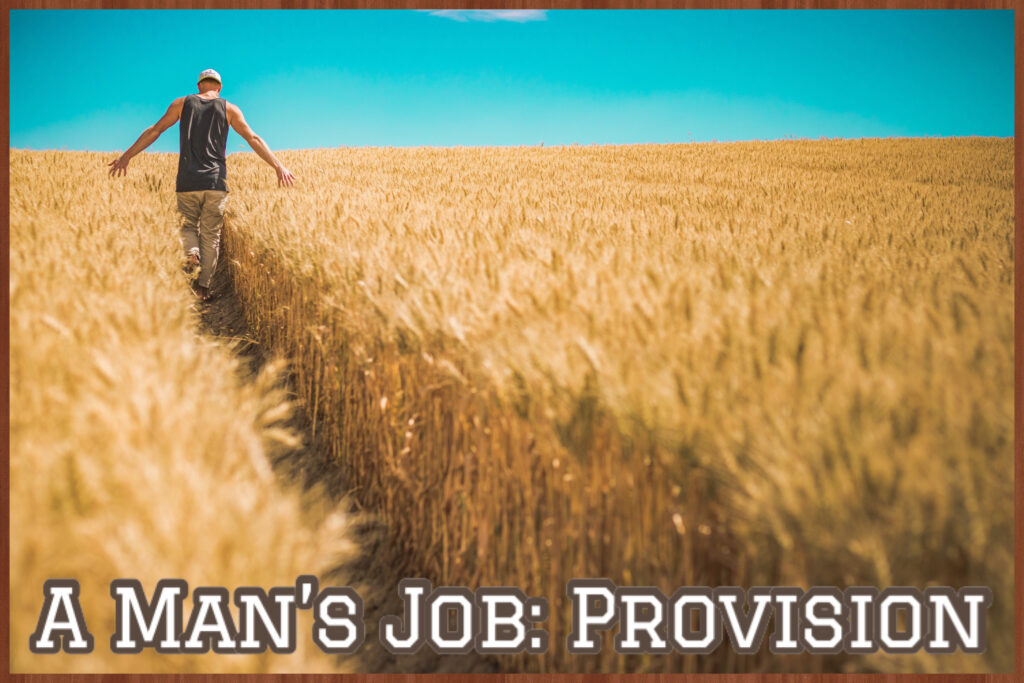
…he may not reduce her food... – cf Exodus 21:10
In Exodus, it was commanded that a man supply the three basic needs of his wife. The first need? Food. It is a man’s job to provide for his family by “bringing home the bacon”. This is not only an Old Testament law, but the principle is reiterated in 1 Timothy 5:8:
..if anyone does not provide for his own, and especially for those of his household, he has denied the faith and is worse than an unbeliever.
While there may at times be a need for a woman to provide supplemental support for the family (if her husband requires and permits such), an able-bodied man is the one who ought to be carrying the lion’s share of his family’s financial burden. When a man is “providing for his own” there is no question as to who is putting the food on the table. Men are uniquely designed by God to be providers for their families.
Some practical ways a wife can support her husband in his job of provision include:
Spending prudently. Bargain hunting. Reselling unwanted/unneeded items. Preparing inexpensive meals. Buying clothing secondhand. And above all, being content with the life he has to offer her on his budget.
Provision is distinctly masculine. Never send a woman to do a man’s job!
Duty is the essence of manhood.
– George S. Patton
#2…

…he may not reduce her clothing… – cf Exodus 21:10
According to Exodus, the second basic need a man must supply for his wife is clothing. Both literally and metaphorically, whenever clothes are mentioned in Scripture, it represents a “covering”. It is a man’s job to protect his family in soma, soul, and spirit. This protective nature of males is likewise repeated in Luke 11:21:
When a strong man, fully armed, guards his own house, his possessions are secure.
(Those “possessions” include his most valuable assets – the wife and kids!)
It’s no secret that the physical strength of the average female pales in comparison to the physical strength of the average male. While a mother should do all in her power to defend her children should a perpetrator come along, the chances of her fighting off an offender (unless of course she holds in her hands “the great equalizer”, A.K.A. a gun) are slim to nothing. Men are uniquely designed by God to be protectors for their families.
Some practical ways a wife can support her husband in his job of protection include:
Upholding boundaries. Steering clear of those individuals that her husband deems questionable. Respecting her own feminine intuition. Being ultra-aware in dark or unfamiliar places. Choosing friends wisely. And above all, keeping close to her tough man – physically, emotionally, and spiritually.
Protection is distinctly masculine. Never send a woman to do a man’s job!
It was men who stopped slavery. It was men who ran up the stairs in the Twin Towers to rescue people. It was men who gave up their seats on the lifeboats of the Titanic. Men are made to take risks and live passionately on behalf of others.
– John Eldredge
#3…
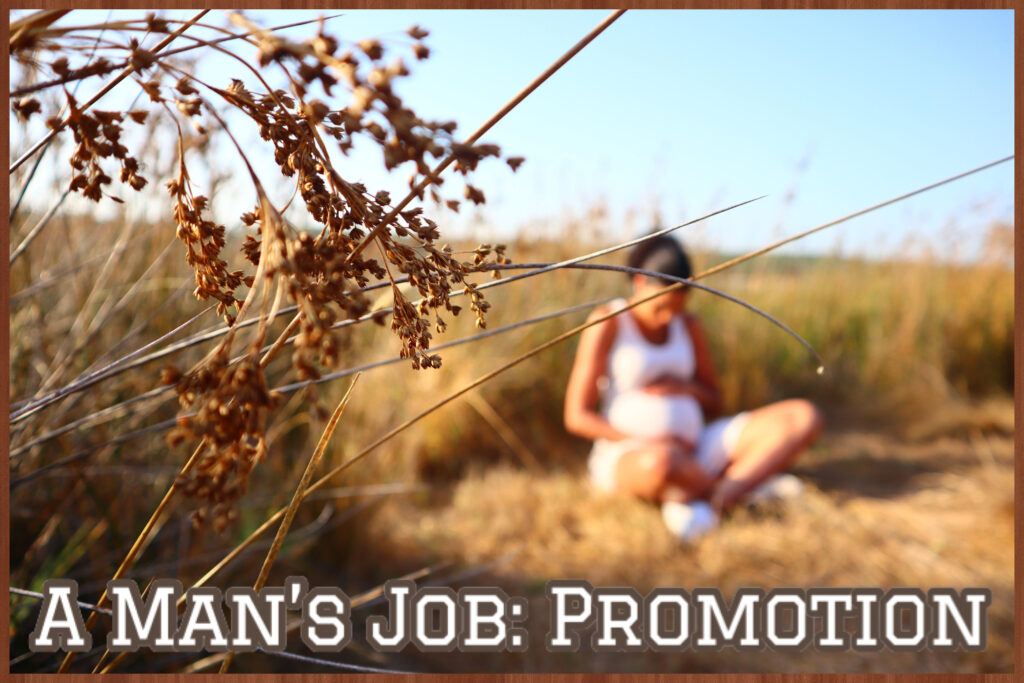
…he may not reduce her conjugal rights… – cf Exodus 21:10
The third need a man must supply to his wife, pursuant to Exodus 21:10, is sex. Many of you may be thinking, “what…sex?! Ew. That’s one duty my husband can shirk. I don’t need that!”…but God says you do. It is a man’s job to promote his family by making love to his wife. 1 Corinthians 7:4 confirms this idea:
The wife does not have authority over her own body, but the husband does; and likewise the husband also does not have authority over his own body, but the wife does.
Having sex with one’s spouse promotes two of God’s greatest gifts: love and children. When a husband and wife make love, they make love. An active sex life is uniting…it bonds a couple in ways they bond with no other. When a husband has sex with his wife (if she engages as a lover and not a martyr), it will promote jubilant feelings within her..she is confident, she is unique, and she is cherished. Furthermore, sex brings about babies. A husband physically promotes the human race by implanting his seed in his wife. He emotionally promotes the children she bears for him by being a present, loving father. He spiritually promotes them by bringing them up in the discipline and instruction of the Lord. Men are uniquely designed by God to be promoters for their families.
Some practical ways a wife can support her husband in his job of promotion include:
Staying open and available sexually. Being interested and engaged in the bedroom. Bearing children for her husband. Exemplifying honor towards the father of her children. Preserving Dad’s command in and out of his presence. And above all, remembering that she is her husband’s lover and her children’s mother, not the other way around.
Promotion is distinctly masculine. Never send a woman to do a man’s job!
A good father is one of the most unsung, unpraised, unnoticed, and yet one of the most valuable assets in our society.
– Billy Graham
In conclusion…
•Provision•Protection•Promotion•
These three masculine responsibilities belong to husbands. What serenity it is to be a woman and have the distinct privilege to take a supportive role in the home, while our husbands take the lead. Don’t be a Pamela Purse, shrieking “ladies first” all the way to your grave. Don’t you know that God knows best? Husbands are called to provide, protect, and promote – and you never send a woman to do a man’s job!
Real women will always be relieved and grateful when men are willing to be men.
– Elisabeth Elliott
For God’s glory,
Mrs. Dustin Bolks
Chaste Bolks is a church of Christ preacher’s wife, and the home educating mother of two children. She and her family currently reside in Northwest Iowa.